Near an eye-catching estuary in Annapolis, Maryland, known as Crab Creek, which feeds the Chesapeake Bay, is a modern stone, stucco and slatted wood house from the vivid imagination of Robert Gurney Architect. Known as Crab Creek House, it is innovatively built on the foundation of a post and beam house from the 1960’s. Perhaps most impressively, its construction adheres to strict environmental regulations of the region, and does so with amazing style and grace.
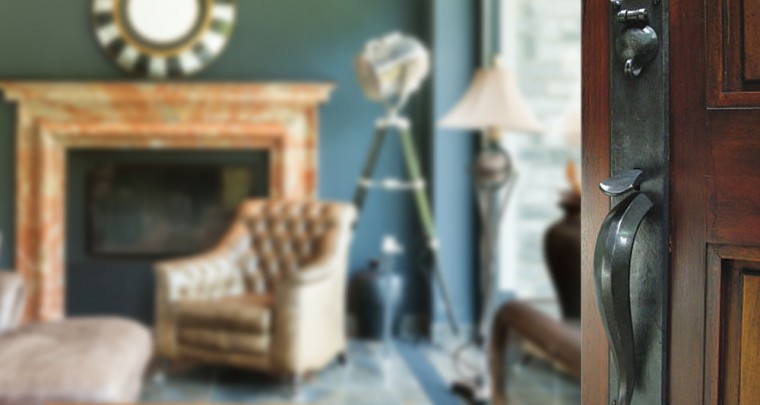
Crab Creek House interior
The central spine of Crab Creek House is a linear bar clad in white stucco around which the rest of the home’s design elements are organized. Additional spaces arise independently and are sided in wood or metal. With a desire to create a strong relationship between the interior of the house and the exterior environment, floor to ceiling windows allow abundant natural light to flood in. Crab Creek House’s main living area offers its occupants expansive water views and features high ceilings and soft neutral tones. An open floor plan creates a space that appears much bigger than it actually is, and utilizes materials such as white oak, black slate, white marble, rusted steel and glass for a visceral and elegant look. The variation in color contrasts and materials makes a bold statement and clearly defines the house’s visual personality. Minimal furnishings and indirect recessed lighting further puts emphasis on thoughtful and balanced living. Occupants may step outside to a private swimming pool, or venture further out into the untouched Maryland woods. Crab Creek House is the ideal home for those who value gorgeous views and a deep connection to nature. Read the rest of this entry »
The National Assembly Building of Bangladesh (Jatiyo Sangshad Bhaban) designed by Louis Kahn
When speaking of the foremost modern architects of the 20th century, it’s impossible not to mention Louis Kahn. Born in Estonia in 1901, Kahn immigrated to the United States and forged an architectural career and body of work that is nothing short of grand and enviable.
Kahn is most notable for his simple, yet highly intimate architectural and design compositions. He was a man who had a genuine sympathy for the site on which he was building and went to great lengths to honor it. Kahn was extremely interested in the look and feel of building materials – brick and concrete were among his favorites – and he would strive to use them in new and innovative ways. He was known for his somewhat obsessive dedication to the use of sunlight and the way it entered a building through windows and other openings. Kahn was also influenced heavily by his travels, which included countries as diverse as Italy, Greece and Egypt. Perhaps more than any other discernable characteristics of his buildings, geometric shapes are featured prominently and with love. Among Kahn’s most notable buildings are the Kimbell Art Museum in Fort Worth, Texas, interesting for its dynamic and curved vaulted ceilings; the Yale Art Gallery in New Haven, Connecticut, beautifully designed in brick and limestone; and the Salk Institute, a research center in La Jolla, California, striking in its starkness and reception of light.
Kimbell Art Museum, Fort Worth, Texas (1966-72)
Of the aforementioned Kimbell Art Museum, Kahn was once quoted as saying, “The building feels…that I had nothing to do with it… that some other hand did it.” While we at Styleture are impressed with Kahn’s modesty, we have no doubt who was at the helm when we are eying his works of architectural genius.
Twentieth century architecture and design would never have been what was if it weren’t for the genius of German-born architect Walter Gropius. Founder of the epic Bauhaus School in Germany – the world’s most famous monument to modernism – and one of the most influential designers and preeminent tastemakers of the movement, his contribution to the field is immeasurable.
Bauhaus (built 1925–1926) in Dessau, Germany
As an architect, Gropius believed passionately in bridging the gap between technology, industry and architecture. He spent his early career in Berlin, including a stint at the firm of Peter Behrens – one of the pioneers of the utilitarian school of thinking. His list of fellow employees at the firm reads like a who’s who of architectural wunderkinds: Ludwig Mies van der Rohe, Le Corbusier, Dietrich Marcks, etc… Eventually Gropius went on to found the Bauhaus school, founded on the principle that all of the arts, including architecture, should be brought under one roof to form a total work of art; this became one of the most influential aspects of modernist architecture. Ultimately, the onset of World War II and the rise of Adolf Hitler eventually drove Gropius out of Germany and he eventually settled in Massachusetts. It was there he formed the professional organization, the Architects Collaborative, and helped carry out the design of many important and world-famous commissions including the Harvard Graduate Center, the U.S. Embassy in Athens, the University of Baghdad, the Pan Am Building and the John F. Kennedy Federal Office Building. Gropius also made his mark in furniture design, creating pieces with the philosophy that modern furniture could be pleasant to look at while still serving form and function. Among his most notable pieces are the F51 armchair and sofa, designed for the Bauhaus director’s room; nowadays remakes of the F51 are available by the German designerTECTA/Lauenfoerde.
In the great pantheon of outstanding modern architects and furniture designers of the 20th century, Marcel Breuer stands out for his inspired works that exude an international flair.
Born in Pecs, Hungary in 1902, Breuer first studied art in Vienna before eventually becoming a student at Bauhaus – Germany’s famed school founded by modern architectural pioneer, Walter Gropius. Breuer’s greatest interest and most prominent talent was in modular construction – the combination of standardized units to form a technically simple but functional complete unit. The Bauhaus school was an ideal place for him to develop and refine this skill set. Eventually, Breuer moved to the U.S. where he set up an architectural studio with Gropius. Together, the two designed the Pennsylvania Pavilion at the 1939 New York’s World Fair, a futuristic exhibit that exemplified their combined range of talents. Soon after, Breuer went on to establish his own architectural practice, entering a 10-year period between 1940 and 1950 that many say was his most productive. During this time, he designed over 60 private homes, including one on the grounds of the Museum of Modern Art that he decorated with endearing plywood furniture. In 1966, Breuer designed one of the masterpieces of modern American architecture: the Whitney Museum of American Art. The building stands out from its neighbors with a staircase facade made from granite stones and external upside-down windows. As a master furniture craftsmen, Breuer made several pieces that are still highly sought after today; most notably the Wassily Chair No. B3, inspired by the shape and form of bicycle handlebars and stellar looking in chrome and canvas.
Whitney Museum of American Art, New York
Wassily Chair
In 1968, Marcel Breuer won the first Jefferson Foundation Medal that cited him “among all the living architects of the world as excelling all others in the quality of his work.” We at Styleture believe the quality of his work continues to set him apart even today.
Frank Lloyd Wright is the greatest figure in 20th-century architecture. There, we said it; and we don’t hear anyone disagreeing with us.
A revered and renowned architect, a pioneer of modernism and the creator of the principle of organic architecture – maintaining that a building should develop out of its natural surroundings – Frank Lloyd Wright displayed the boldest of originality and rebelled against the ornate styles of his predecessors. He was a firm believer in meticulously selecting building materials to maximize a structure’s functionality. His exteriors emphasized the beauty of natural colors and textures and his interiors emphasized the freedom of spaciousness. Though his genius is clear in hindsight, Frank Lloyd Wright wasn’t celebrated by all back in his day; more conventional architects often slammed his unorthodox methods and at one point, the relentless antagonism sent him into exile in Europe. However, upon his return he created some of his most notable works: the Imperial Hotel in Tokyo, an engineering feat; the Guggenheim Museum in New York City, a curvilinear masterpiece; and the Fallingwater residence at Bear Run, Pennsylvania, a clear favorite of even the most jaded architecture buffs. If that wasn’t enough, Frank Lloyd Wright also created heirloom quality furniture pieces worthy of the finest modern homes.
Widely regarded as the “father of modern architecture,” Ludwig Mies van der Rohe was an original thinker, a passionate worker and not only designed impressive and groundbreaking structures, but also dabbled in interiors and furniture.
A German-American, Mies came to prominence during the first half of the 20th century and brought clarity and simplicity to the world of building design. Utilizing industrial steel and plate glass to define starkly elegant spaces, like the National Gallery in Berlin, Mies kicked off a rapid transformation in the architectural world that is admired and emulated to this day. He also designed modern furniture pieces like the Barcelona and Brno chairs. His furniture pieces particularly exemplify his flair for interiors and his ability to use delicate frames and cantilevers to produce exquisite and functional pieces.
Mies once said, “I don’t want to be interesting, I want to be good.” We at Styleture have no doubt that he was both.
National Gallery in Berlin (Photo by K.lee, available under a Creative Commons Attribution-Share Alike 3.0 Unported license)
We’ve discussed our affinity for Mid-Century Modern homes in the past (see: here and here), so we were quite surprised when we discovered the existence of a fantastic looking documentary called Leisurama.
The film tells the story of a 1960’s department store that featured full-scale models of Mid-Century Modern homes that were part of a housing development called “Leisurama.” The homes were on the 9th floor of the Macy’s Herald Square store in Manhattan and were a huge hit among shoppers not expecting to encounter an entire home while shopping for such things as a new winter coat.
This collaboration between Macy’s and Leisurama was meant to promote a new type of modern home. The models were fully decorated and furnished, all the way down to the toothbrushes and toilet paper.
Watch the video below to learn more about this wonderful quirk in the history books of American modernism.